

Writing
Does SEO still matter? I asked Google for the best plumber in Krugersdorp — twice.
The same search, seven days apart, and almost none of it held.

I keep seeing a version of the same question. If people are asking AI for recommendations now, is there any point in SEO?
It’s the right instinct and the wrong question. SEO was never the point. Being found was the point. SEO was just the shape that being found happened to take for about twenty years.
So I went and looked at what the shape is now. One search: best plumber in Krugersdorp.
I ran it on the 4th of August. Then, because I was going to publish what I found, I ran the identical search again on the 11th. Same laptop, same account, same town, same wording.
I’m glad I did, because almost nothing I was about to tell you survived the second run.
The first run
Google’s AI Mode gave me three names. MMC Plumbers, PlumbPros Plumbing, Pink Plumbers. Highest rated, it said, based on customer reviews and professional standing.
Then it laid each one out the way a person would if you’d phoned them for a recommendation. Rating: 5.0 out of 5, from 42 reviews. Address: 364 Main Reef Road, Wentworth Park. Open 24 hours, Monday to Sunday. Core focus: emergency plumbing, leak detection, burst pipes, geyser replacement.
And then this line, which is the reason I started writing any of this down:
Reviewers consistently praise Matthew and his team for quick turnaround times during emergencies.
It read the reviews. It pulled a first name out of them. And it repeated that to me — a stranger, looking for a plumber, before I had spoken to a single human being.
Down the right-hand side it showed its sources. Twenty sites consulted, and every citation attached to those three businesses pointed at one place: their Google Business Profiles. The free listing. Not one plumber’s own website.
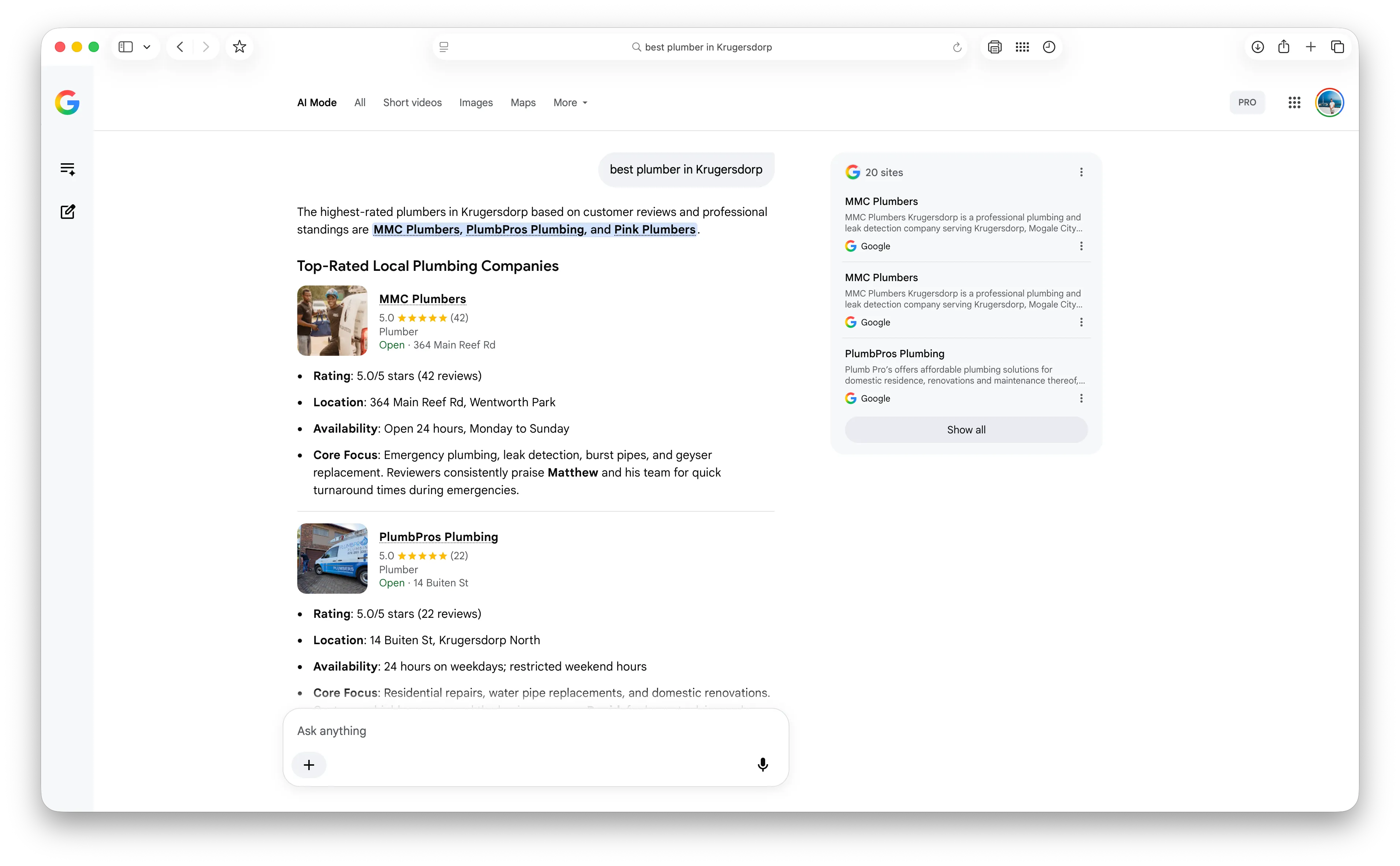 4 August. Every visible citation is a Google Business Profile. The names, the hours and the “core focus” list are all lifted from the free listing.
Then I checked the ordinary results tab. Same query, no AI. The top of the page was four adverts. DrainCo, blocked drains from R950. A247, 25 years’ experience. theplumbers.co.za, family run. Alpha Plumbing, trading since 1989, 450+ five-star reviews. Serious businesses, spending real money to sit at the top of that exact search.
Not one of the four was in the AI’s answer.
I had my article. It practically wrote itself: the machine reads your Google profile, not your website, and you can buy the top of the page but you can’t buy the answer.
Then I ran it again.
The second run, seven days later
Pink Plumbers was gone from the answer, replaced by Thatolebana Plumbing Solutions — with Alpha Plumbing and Clear Blue Plumbing added underneath as “highly recommended alternative experts nearby”. Alpha Plumbing being one of the four advertisers from the week before.
The sources had changed as well. Not Google profiles this time: a plumbing company’s own website, a directory called Procompare, and an About.me page.
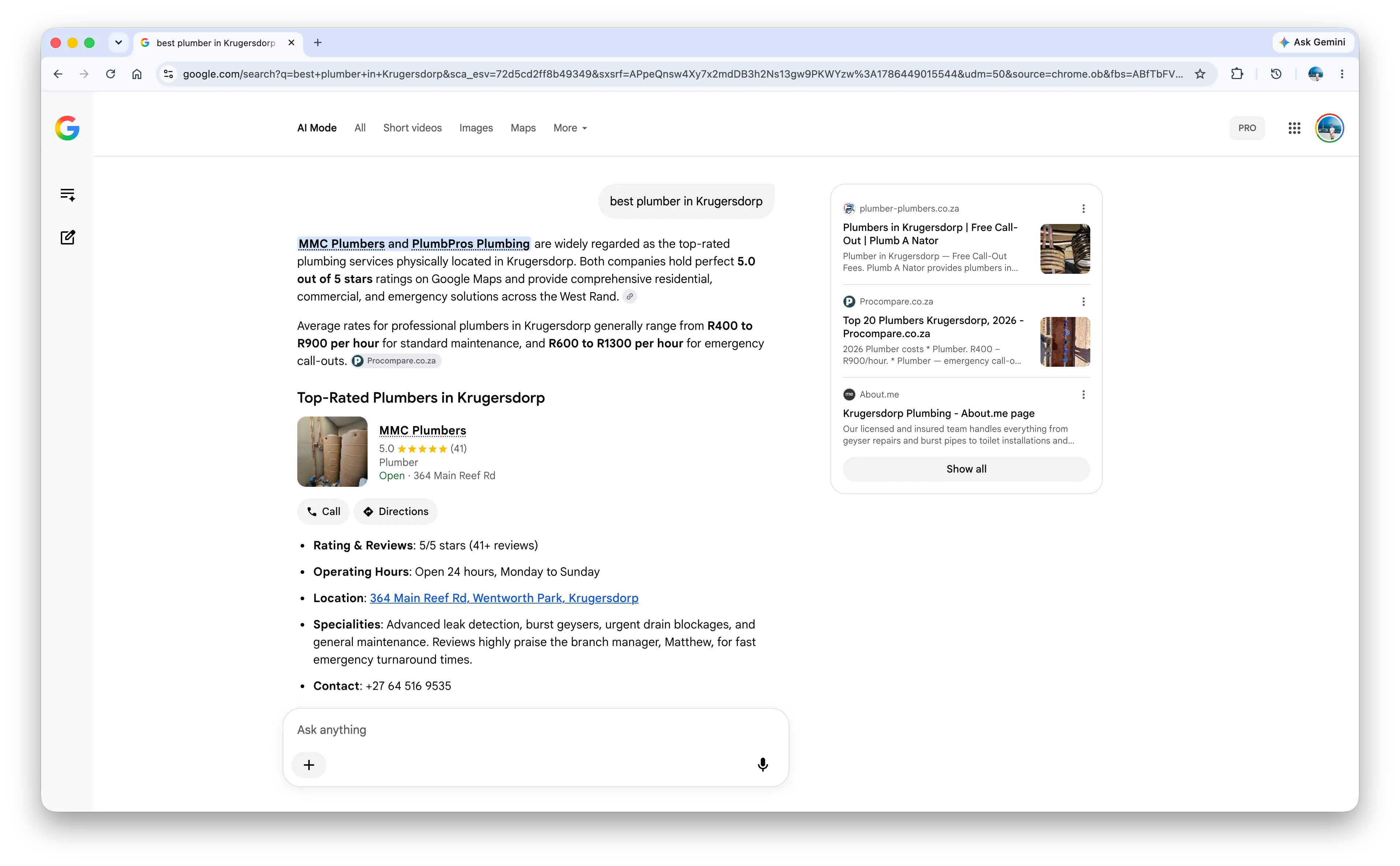 11 August, same query, same account. The sources panel sits in the same place — compare it with the one above.
It was now quoting hourly rates — R400 to R900 for standard work, R600 to R1300 for emergency call-outs — credited to that directory. The week before it hadn’t mentioned money once.
And the four adverts?
Gone. Not pushed down the page, not fewer. I scrolled the results to the bottom and there was not one paid result anywhere on it.
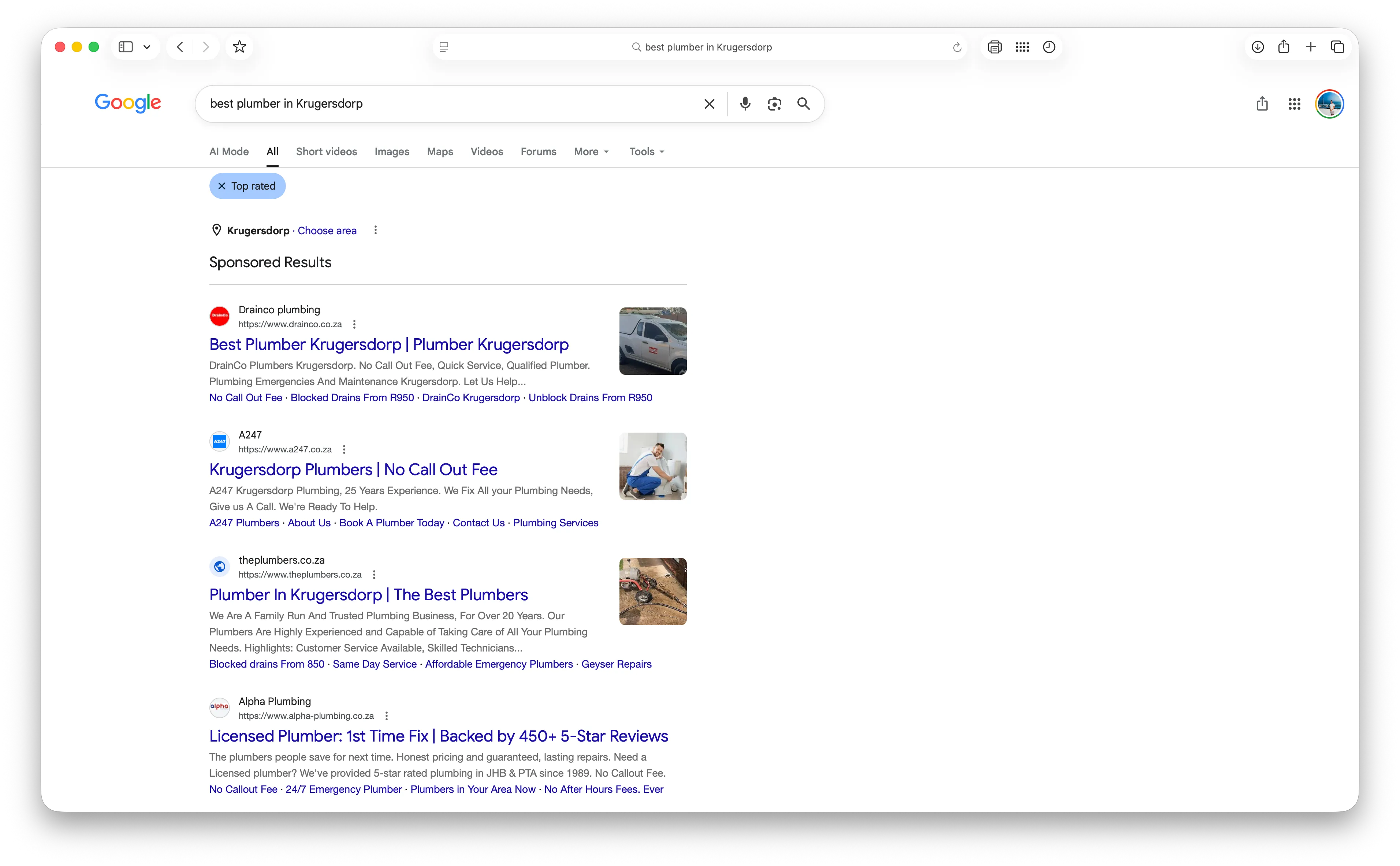 4 August, the ordinary results tab. Four adverts, all above the fold.
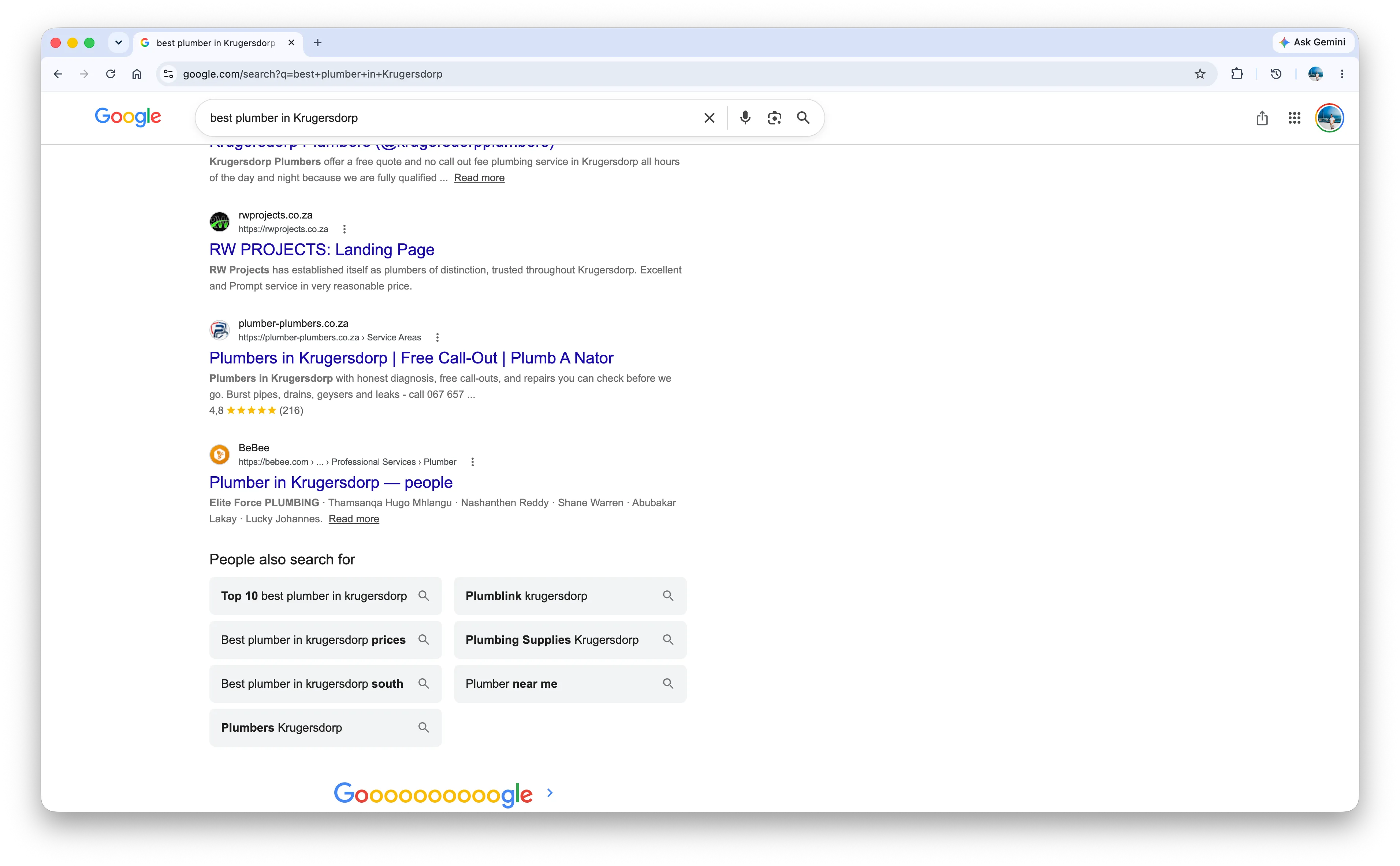 11 August, scrolled to the pagination footer. Not one paid result on the page.
Same search. Same laptop. Seven days.
| What changed | 4 August | 11 August |
|---|---|---|
| AI Mode picks | MMC, PlumbPros, Pink Plumbers | MMC, PlumbPros, Thatolebana |
| Cited sources | All Google Business Profiles | A company website, Procompare, About.me |
| Price in the answer | None | R400–R900/hr, R600–R1300 emergency |
| First names quoted | Matthew | Matthew, David, Thato, Brandon |
| Adverts on the All tab | Four, all above the fold | Zero, confirmed to the footer |
Two searches, one town, a week apart, on a logged-in account with the location set. I’m not pretending that’s a study. But it is two, and one would have had me telling you something false.
What actually held
Two things survived both runs, and they are the only two I would act on.
The first is who kept getting picked. MMC Plumbers and PlumbPros Plumbing were in the AI’s answer both times, and in the ordinary business panel both times. Both sitting on a perfect 5.0. Everything around them moved. They didn’t.
The second is the names.
The first run quoted Matthew. The second run quoted Matthew again — and David at PlumbPros, and Thato at Thatolebana, and Brandon at Clear Blue. Four people’s first names, read out of review text and handed to a stranger who had asked a machine for a plumber.
That isn’t a glitch and it isn’t going away.
Your reviews are no longer feedback. They are the copy that sells you, written by your customers, quoted by a machine, to someone who has never heard of you.
Which makes most of the advice unsellable
If the answer moves this much in a week, nobody can sell you a place in it. Anyone offering to get your business “into AI search” is selling you a snapshot of a page that will look different by the time the invoice clears.
What nobody can change on you is what the machine had to work with. A rating and a number of reviews. A verified address. Hours it could state confidently. A description of the work in the words people actually use when they phone — burst pipes, geysers, leak detection. And enough review text to say something specific about, rather than “customers are happy”.
Every one of those lives on a free Google profile that takes an afternoon to fill in properly, and that most businesses in this country have half-finished or have never claimed at all.
That’s the qualification. It was the qualification before any of this, which is rather the point.
Most of the advice you’ll read is American, and it will tell you to sort out your Angi profile, your HomeAdvisor listing, your Nextdoor presence and your BBB rating. Four platforms that don’t exist here.
Our list is different, and the second search told me exactly what it is. On that one page: Snupit. Procompare. Bark. BeBee. And a Krugersdorp plumbers Facebook page with 920 followers.
So: your Google Business Profile. Facebook, which is still where half the country asks the neighbourhood who to phone. Hellopeter, where South Africans go both to complain and to check before they commit. And whichever of Snupit, Bark or Procompare your trade actually sits on.
If somebody sells you an AI search package built on the American list, they haven’t checked.
The scale of it, briefly
Two thirds of Google searches now end without anyone clicking anything — 68% in the first four months of 2026, up from 60% in 2024. In the same period, the share of consumers who say they have used an AI tool to find a local business went from 6% to 45%. It is now the third most common way people find a business, behind Google and Facebook, ahead of Yelp.
Both of those are United States figures. Nobody publishes an equivalent for South Africa, so treat the numbers as borrowed. Sources and confidence are at the foot of this piece.
The behaviour isn’t borrowed. Microsoft’s diffusion report puts South African use of generative AI at 23.1% of everyone aged 15 to 64 in the first quarter of this year, the highest in Africa. Google AI Mode launched here in August 2025, and in March it started answering in Afrikaans, Sotho, Setswana and isiZulu.
It is running here, in our languages, and I have just watched it hand out phone numbers on the West Rand.
And then the loop closes
Here’s where the panic story falls apart entirely.
Of the people who ask an AI for a local recommendation, 88% then go and check it. Half verify the business is real. A third go and read the sources it cited. And 97% at least sometimes cross-check against actual reviews on the actual platforms. Four in ten always do.
The AI recommendation isn’t the decision. It’s the shortlist.
So the journey is: ask, get three names, go and look those names up on Google, read the recent reviews, phone one.
Go and look those names up on Google. That’s the old game. It never stopped. The same profile that got you into the answer is the profile that has to survive the check afterwards.
Which means the thing that makes you visible to the machine and the thing that has always won you the map pack are one and the same asset. SEO didn’t die. For a local service business it just got demoted from destination to input — and the input was never really your website. It was whether you are verifiably good in public.
What I’d actually do
None of this is clever, which is exactly why so few businesses do it.
Claim and finish your Google Business Profile. Every field. Hours that are true, services listed in the words customers use, real photographs, the questions people actually ask.
Write your own description properly, because there is now a decent chance a machine reads it aloud to a customer.
Make your name, address and phone number identical everywhere they appear. One afternoon, genuinely.
Ask for a review after every completed job, permanently, instead of in bursts when you remember. Forty reviews from 2023 describes a business that used to be good.
And read your reviews as marketing copy, because that is now what they are. A review that says “came out on a Sunday night and sorted the geyser before the ceiling came down” is worth more than any sentence you will ever write about yourself, and it’s the one that gets quoted back.
The part nobody mentions
I don’t sell SEO and I don’t run ads, so I’ve no reason to talk either up or down. What I install is the system underneath — the enquiries landing in one place, the follow-ups, the review requests going out on their own after every job.
Which is why I keep noticing the same thing from the other side of it.
That first listing said: open 24 hours, Monday to Sunday. That sits on the profile, so the AI repeated it, so somebody standing under a burst geyser is going to phone at eleven at night on the strength of it.
And at eleven at night you’re asleep. Or it’s two in the afternoon and you’re on a job in Randfontein with your arm down somebody’s drain and your phone in the bakkie.
Getting into the answer is half the job. The other half is being there when the answer sends somebody to you. A missed call at that point isn’t really a missed call — it’s a customer who was found, convinced and delivered to your door by a machine, and then handed straight to the next name on the list by your voicemail.
Better visibility on top of a phone nobody answers just means losing better-qualified work, faster. I’d sort that end out first.
Method, and how to repeat it
If you want to run this yourself — and you should, for your own trade and your own town — two things will bite you.
The query gets rewritten. Two of my attempts came back as Plumber in krugersdorp instead of
best plumber in Krugersdorp, because I reached them by clicking a refinement chip. That appends a
uds= parameter and silently changes the query string. Paste the URL into the address bar and touch
nothing. Check the URL before you screenshot.
“Best” changes the page. Google auto-applies its Top rated filter to queries containing the
word “best”. On Plumber in krugersdorp all three chips sat unselected. So the two queries are not
the same query, and comparing them is a mistake I nearly made.
And the general lesson, which is worth more than this article: a single observation of a machine-generated page is a snapshot, not a finding. Anything measured off one AI answer has to be re-run before you publish it under your name. It’s cheap, and here it turned a piece that would have been publicly wrong within a week into the only part I trust.
Sources
Marked by confidence and geography, because most published material on this topic is US vendor content and half of it does not survive contact with South Africa.
| Claim | Source | Confidence |
|---|---|---|
| 68% of Google searches end without a click (Jan–Apr 2026) | SparkToro / Similarweb clickstream, US panel | High — clickstream, methodology published |
| 6% → 45% used AI to find a local business | BrightLocal Local Consumer Review Survey, Feb 2026, n=1002, US | High for the sample, unknown transfer to SA |
| 88% fact-check the recommendation; 97% cross-check reviews | Same BrightLocal survey, US | High for the sample |
| 23.1% of South Africans 15–64 used generative AI, Q1 2026 | Microsoft Global AI Diffusion, reported by TechCentral, BusinessDay, ITWeb | High — three SA outlets |
| Google AI Mode launched in SA, 21 August 2025 | Contemporaneous SA press | High |
| Afrikaans, Sotho, Setswana, isiZulu added, March 2026 | SA tech press | High |
| Everything about the Krugersdorp searches | My own screenshots, 4 and 11 August 2026 | First-party. Two runs, one town, one account. |
There is no South African equivalent of the clickstream or consumer-survey data. Where I’ve used US figures I’ve said so in the text, and I’d treat them as direction rather than magnitude.
A shorter version of this appeared on LinkedIn on 20 August 2026.